
Hermetically-sealed inside a blacked-out thermal vacuum (TVAC) chamber, a one-of-a-kind electro-optical space camera faces the temperature extremes it will see in orbit: baking on one side of its cycle, brutally cold on the other.
In early 2026, Optimum Technologies™ was standing up a brand-new TVAC facility. Everything about the test was new: new chamber, new payload, and the first run of everything.
The chamber itself was purchased and en route for installation, but with the test date on the horizon, critical pieces still didn't exist: a data acquisition (DAQ) system for logging dozens upon dozens of sensor readings through weeks of continuous testing, a triggering system to activate survival heaters for flight hardware, and a way to turn orbital thermal predictions into a physical logic mapping those elements together—in real time.
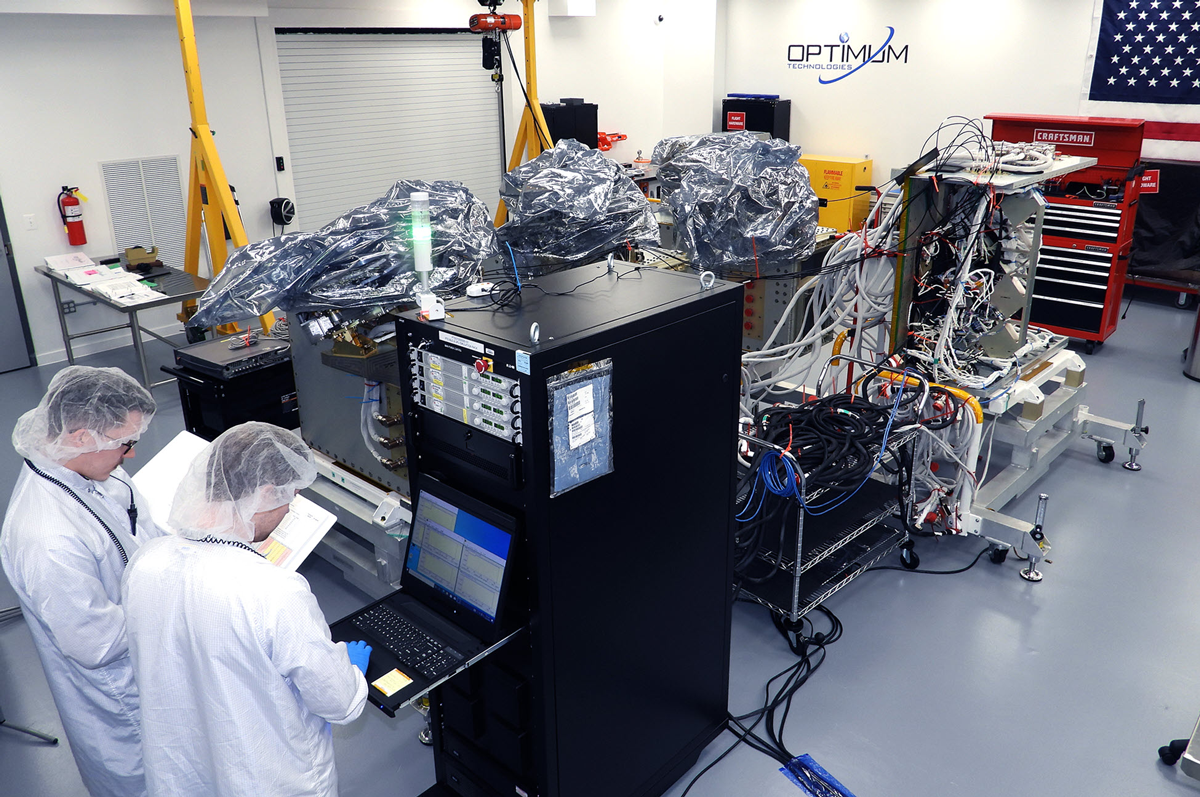
Optimum Technologies, a company that helps organizations put hardware in space, decided to stand up a new thermal vacuum (TVAC) chamber.
Proving Hardware That Has to Survive Space
Optimum Technologies (OpTech), based in Sterling, Virginia, helps organizations put hardware in space. The company designs mission architectures, builds and tests spacecraft systems, fabricates flight harnesses, and develops its own sensor-based payloads, including Caracal™, a 35 cm electro-optical telescope built for space domain awareness.
But before any payload flies, OpTech must prove it can survive in space, and TVAC testing is an indispensable link in the chain of that proof. The chamber uses vacuum pumps to emulate the conditions of space, then uses liquid nitrogen and electrical heaters to cycle the hardware through orbital hot and cold worst-case temperatures. The purpose is threefold: prove that the design can survive these extremes, mechanically stress every circuit in the unit to shake out any workmanship failures, and validate the thermal models engineers use to predict how it will behave once it’s in orbit.
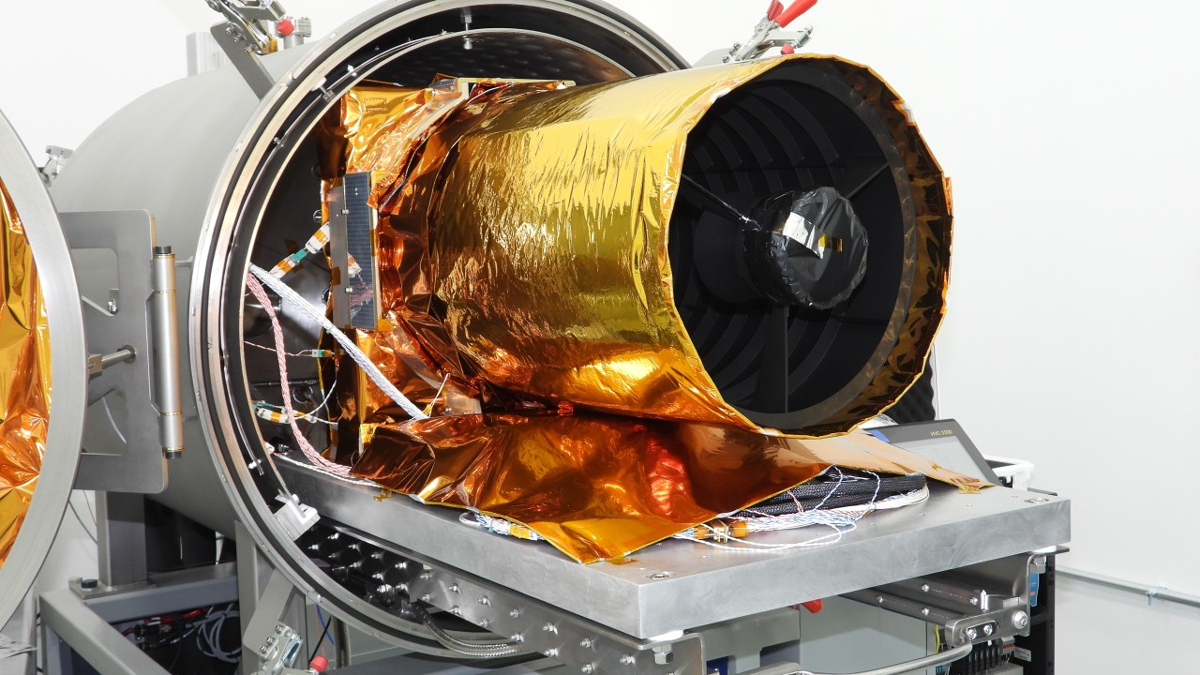
Optimum Technologies helps organizations put hardware in space, including their Caracal, an electro-optical telescope.
A Spec That Read Like a Flight Computer
The requirements were straightforward to describe and demanding to satisfy. OpTech needed something to acquire thermocouple data from sensors on the unit under test, switch heater circuits on and off according to whatever logic the thermal engineers dreamed up, log all of it, display it on clean live screens, and let engineers on the team reach it remotely and securely.
“A lot of what we wanted is what we’d ask a spacecraft to do: remote access, sensor data, actuation, triggering. That’s basically it. It was almost like specifying a flight computer,” says Stephen Gordinier, space systems engineer at OpTech.
One hard line ran through everything: no cloud connections. But that didn't mean no remote access: it meant no dependence on anyone else's servers. Plenty of industrial systems “phone home” to a vendor's cloud to light up dashboards or enable a remote connection.
OpTech wanted none of that. The system had to run entirely on hardware the team controlled, with no recurring licenses and as few moving parts as possible. They needed a “brain in a box,” wired to sensors and quietly logging data while it displayed live feeds on good-looking screens.
Remote access was still a requirement, but it had to be built on OpTech's own terms. Gordinier is a remote consultant based out of Kentucky, and the chamber is in Virginia. He needed to reach the system securely from several states away, but using a connection he controlled, not a third-party service.
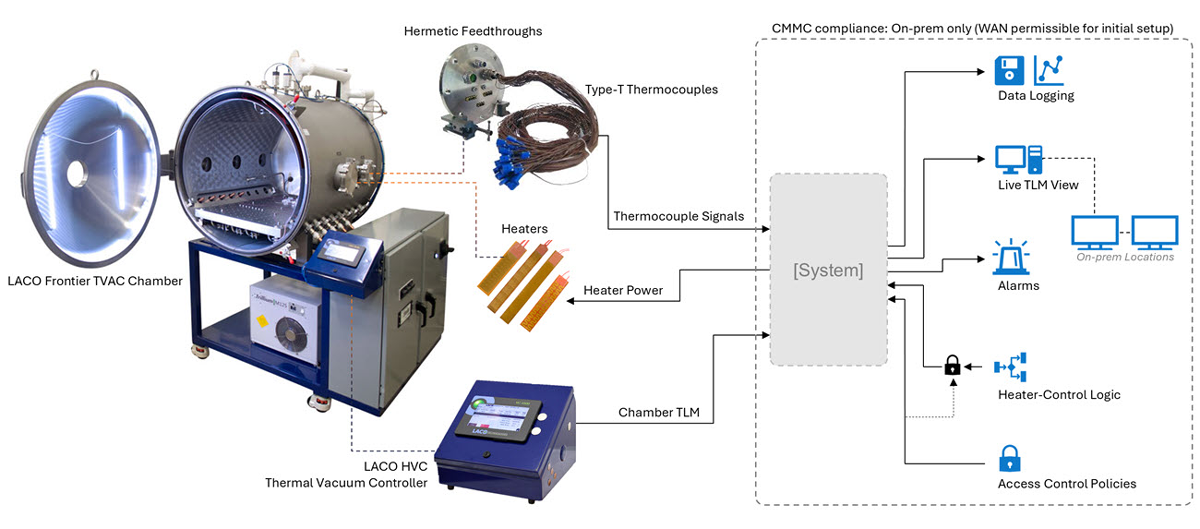
To complete the new TVAC chamber facility, Optimum Technologies needed to find a system that could provide remote access, data acquisition and logging, heater-control logic, and more.
Finding the Right Brain
Gordinier did what a systems engineer does: he ran a formal trade study. He started by framing the scenario to an AI assistant to rough out a decision-making framework and get some initial research leads—leading him to realize that this project was essentially a matter of industrial controls, a field with which he had no experience. The research threads turned into tab groups overflowing with search results, online forums, and data sheets, and he kept circling back to the same name: Opto 22.
The lab-standard answer for this kind of work is a big-name, benchtop DAQ system, and Gordinier looked hard at that world. But the more he dug, the more the established options came up short for what OpTech needed.
Several of the systems studied couldn’t store data locally; they only streamed, which meant a dropped connection or a power blip would cost a test run. Cheaper standalone data loggers that log data locally might save money on the data acquisition side, but they didn’t have control engines to run all the heater-switching logic.
“The most capable systems were also the most expensive, especially with software licensing and subscription fees. Those are silent killers,” Gordinier says. OpTech runs a lean operation.
Opto 22’s
groov EPIC (
Edge
Programmable
Industrial
Controller) checked the boxes the others couldn’t. It’s a modular edge controller with the thermocouple accuracy and channel count Optimum Technologies needed. It runs control logic and visualization locally. And since
groov EPIC can store data on-board, resilience is built in rather than bolted on. Nothing required a license or subscription fee.
On paper,
groov EPIC met the requirements. What Gordinier didn't expect was a surprising point of familiarity:
groov EPIC runs the same open-source Yocto Linux
® that OpTech uses on its flight computers, with secure shell (SSH) access included.
This meant the controller wasn't foreign hardware they had to learn—it was an environment they already knew. They could work on it with confidence from day one.
And then there was the price. For everything
groov EPIC packed in, Gordinier expected to pay a premium. Instead it came in as the least expensive option that met every requirement, at a fraction of the cost of the licensed benchtop systems he started with.
“We wanted to branch out into openly available tech, and
groov EPIC ended up being the most economical and the easiest to use,” says Gordinier.
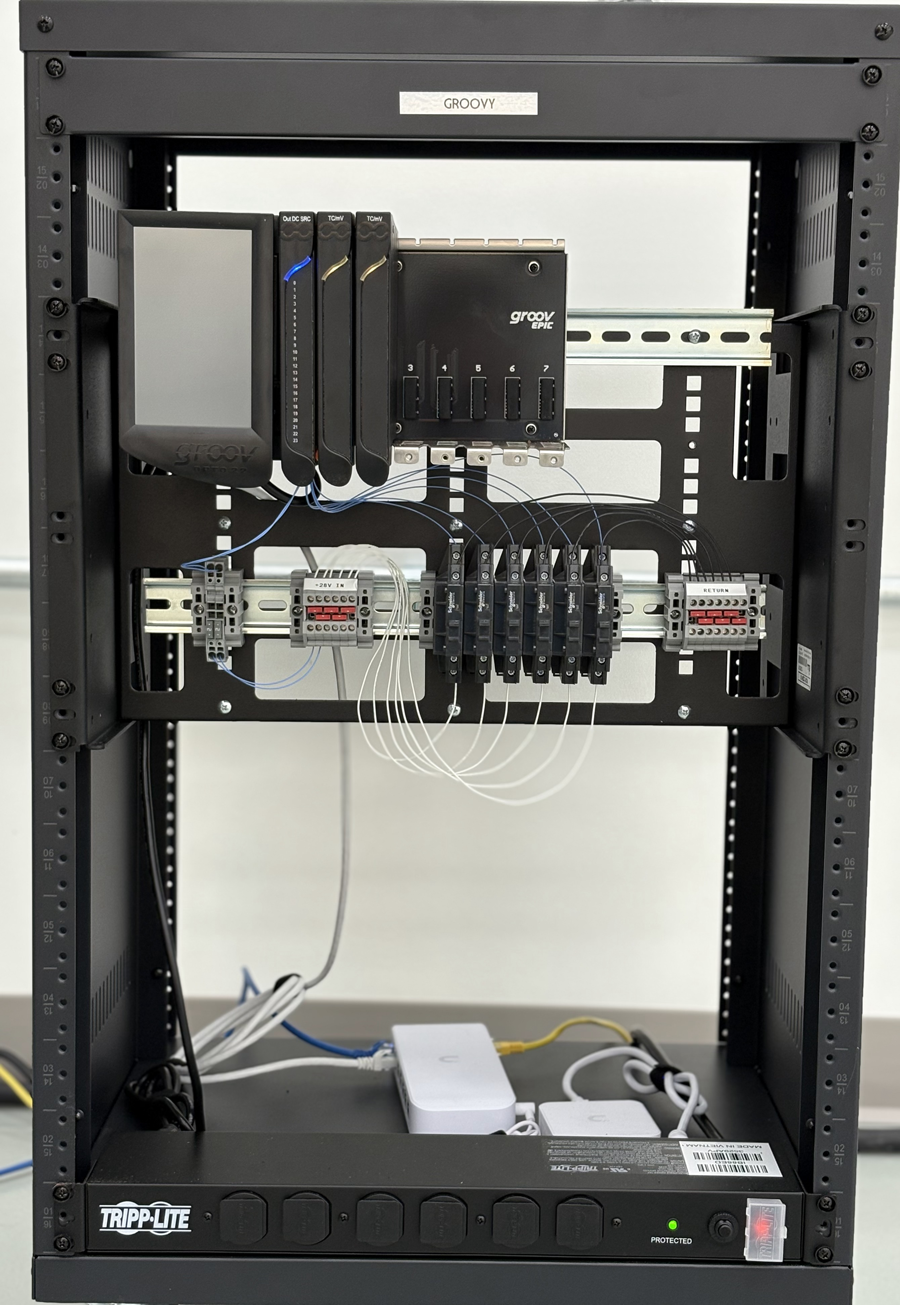
If test requirements grow, the compact groov EPIC system can grow with them.
A Week to Build It
Gordinier designed the whole system sight unseen, and then OpTech flew him out to build the rack on-site. He had never programmed a PLC or wired industrial I/O before. He expected friction, but he didn’t find much.
“Everything just worked out of the box. It was plug-and-play. It just went. I kept asking myself, ‘How am I going to test this or that?’ And then it just worked. I built it in a week, having never touched it,” Gordinier says.
For control logic, Gordinier turned to
Node-RED, a free IIoT development tool built into every
groov device. He also used Node-RED’s “Write File” nodes to save test run data on
groov EPIC’s local memory in .csv files. For the screens he used
groov View, the web-based HMI included with every
groov EPIC, building clean, informative displays of test status and trends.
The one real learning curve was Node-RED itself, which took Gordinier longer to master once he was back home, but he wasn't on his own. Opto 22's
training videos carried much of that weight, and Gordinier singles out Terry Orchard's
tutorials as “methodical and clear.”
Remote access came together exactly the way Optimum Technologies wanted it, on its own terms. Gordinier connects over a WireGuard® VPN into a small, isolated LAN that connects only the
groov EPIC. The “no-cloud-but-reachable-from-three-states-away” requirement was met with no compromise.
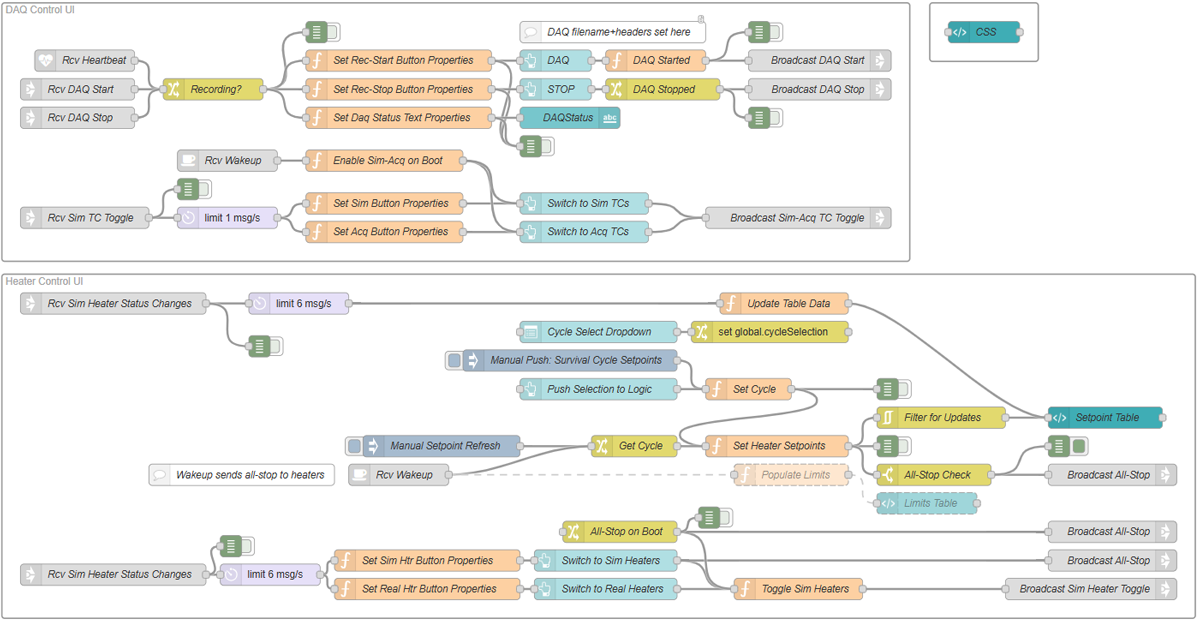
Node-RED provided Optimum Technologies the control logic needed at no additional licensing costs.
Inside the TVAC Control System
The delivered system is compact: a single
groov EPIC chassis holding the processor, an AC power supply, and the I/O modules that connect it to the test:
- A groov EPIC processor (GRV-EPIC-PR1) runs the show with real-time control, data handling, and visualization.
- Two 12-channel thermocouple input modules (GRV-ITM-12) read the Type-T thermocouples monitoring the unit under test.
- A 24-channel DC digital output module (GRV-ODCSRC-24) switches the relays that drive the heater circuits.
- A groov EPIC chassis (GRV-EPIC-CHS8) and AC power supply (GRV-EPIC-PSAC) round out the hardware, with room to add modules as the facility or test requirements grow.
Together the system monitors up to 24 thermocouple channels and logs continuously to on-board storage (at 1 Hz), with room to grow—OpTech has more test campaigns in the pipeline that will require substantial I/O expansion.
Rock Solid...and Watching
So the test began, and the system Gordinier had built in a week simply just…ran. Through every hot and cold cycle, logging around the clock, it never dropped a reading and never went down. That mattered more than usual because everything around it was on its first run. The new chamber and its controller had a few small issues that you’d expect from new equipment. The
groov EPIC had none.
“It was rock solid. Not a glitch, not one. No downtime,” Gordinier says.
Then it did something no one asked it to do: because the groov EPIC logs continuously, even when no test is running, Gordinier caught the thermocouple readings spiking and swinging erratically during idle periods, the kind of anomaly that never shows up when a system only records during a formal test. OpTech’s on-site Integration & Test (I&T) team took the cue and chased it down. The culprit wasn't the EPIC or the sensors. It was a grounding fault in the brand-new chamber itself. The control system had found a hardware problem in the facility that everything else had missed. Left undetected, that fault could have quietly skewed test data across future runs.
For a facility where the chamber, the payload, and the control system were all first-of-their-kind, getting through the campaign with nothing going wrong on the controls side was, in Gordinier’s words, “Pretty wild.”
What Comes Next
Optimum Technologies now treats
groov EPIC as standing infrastructure. Thermistor modules are already on order for the next campaign.
“It’s always on and always running,” Gordinier says, “so we’re always finding new ways to use it.”
The team plans to connect the
groov EPIC to the TVAC’s local controller over Modbus®/TCP to build a single dashboard that shows both the payload and the chamber state. The next TVAC testing round will likely hand the
groov EPIC more responsibility, directly driving flight heaters and potentially acting as a stimulator that drives voltages to emulate the space environment.
They also plan to put the
groov EPIC's Node-RED flows under Git® version control, managed over SSH, so every change to test logic is tracked and reversible—the same discipline OpTech applies to its flight software.
Gordinier’s advice for anyone attempting something similar has nothing to do with the hardware and everything to do with discipline: decouple physical channel addresses from the logical locations they represent. Don’t assume “TC1” always lives in one spot. Keep that mapping in a single place, so when a sensor moves, there’s exactly one thing to update.
But the bigger takeaway is simpler. With the right edge platform, a space systems engineer who had never touched industrial controls stood up a secure, reliable, on-premises test system in a week, and then got out of the way and let it run.
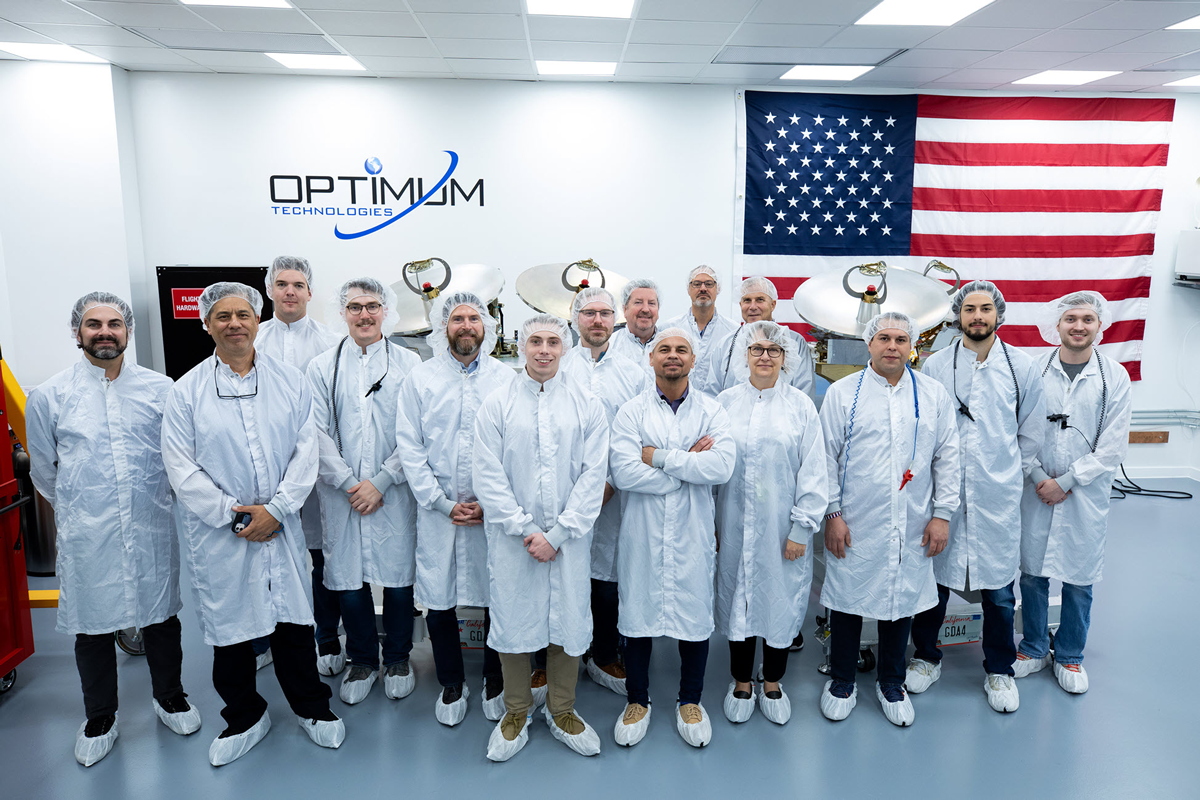
The team at Optimum Technologies plans to use the groov EPIC as foundational infrastructure.
About Optimum Technologies
Optimum Technologies is a space and defense engineering company based in Sterling, Virginia. The company provides space mission consulting and systems engineering; integration, test, and flight-harness services; and its own sensor-based payloads, including the Caracal electro-optical telescope for space domain awareness. From mission architecture through build and test, OpTech helps customers design, assemble, and qualify the hardware they need to fly.
For more information, see:
https://www.optechspace.com
Download case study pdf